
Learn exactly how GPA works in US universities, from the 4.0 scale to weighted versus unweighted cumulative GPA, and how it matters for scholarships, grad school, and yeah, your whole career path too. Full 2026 guide, ok?
If you are an international student, or even a domestic student just stepping into college, the American GPA setup can feel kind of tangled right away. Like, what does a 3.7 really mean? How do they figure it out, step-by-step, for real? Why do certain colleges keep it on a 4.0 system while others go above it and can even reach something like a 5.0? And honestly, the most important thing is, how much does GPA actually matter for the future you’re aiming at?
This full guide covers every question you have about how GPA works in the USA universities. When you finish reading, you will understand the system clearly, and you will know the exact moves to protect, then boost, your GPA.
What Is a GPA? (Basic Definition)
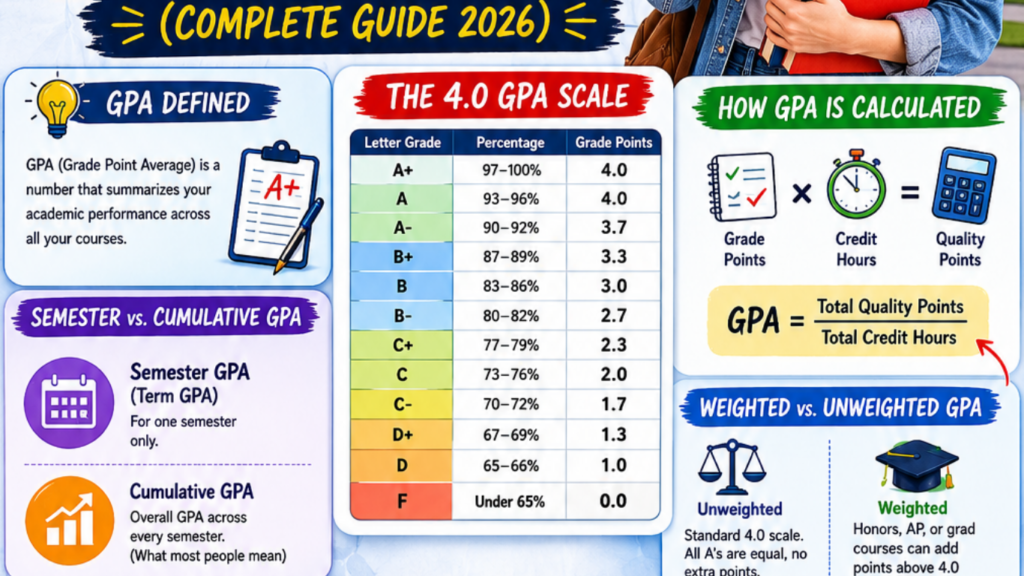
GPA is basically short for “grade point average.” Like, it’s that one number that sort of sums up how you’ve been doing at school, across all your classes, at a university.
In the United States, most universities treat GPA as the go-to signal for student achievement, kind of the headline thing. Rather than laying out every single mark you earned, your GPA takes your whole academic history and bundles it into one single neat figure, usually on a 4.0 scale.
You can sort of picture it like this: if you pull an A in each class, your GPA really lands at 4.0.
If you only manage Bs everywhere, it sits nearer 3.0. So, you know, the bigger the number, the better academic standing, even if the exact conversion details shift a bit depending on the course.
The 4.0 GPA Scale—How It Works
Most US schools show the 4.0 version. So, here’s the common mapping between letter grades and GPA grade points, ya know, the usual deal, like, it’s mostly consistent, but not always the same everywhere (especially when departments get picky or someone uses a slightly different system):
| Letter Grade | Percentage Range | Grade Points (GPA) |
Grade
| A+ | 97–100% | 4.0 |
| A | 93–96% | 4.0 |
| A- | 90–92% | 3.7 |
| B+ | 87–89% | 3.3 |
| B | 83–86% | 3.0 |
| B- | 80–82% | 2.7 |
| C+ | 77–79% | 2.3 |
| C | 73–76% | 2.0 |
| C- | 70–72% | 1.7 |
| D+ | 67–69% | 1.3 |
| D | 65–66% | 1.0 |
| F | Under 65% | 0.0 |
Quick thing though… schools don’t always sort of march the same grade ladder, not really. Like, some places take an A+ and make it a 4.3 instead of that common 4.0, and then suddenly the whole chart feels a bit weird, at least the first go-around, kind of like, “Why is it different, right?” Also, yeah, it can get more nuanced too, depending on the district or even the college policy, you know.
So yeah, you should re-check with your university’s actual grading rules. Most times, it’s in the student handbook or another academic policy page. Usually, there’s some link somewhere, too.
How is GPA basically put together?
Most folks assume it’s just the average of your grades, but GPA is typically more like a weighted mean, where each class shows up based on credit hours, not just the letter result you got.
Here’s a sort of fuzzy, step-by-step version, not fully official, kind of general:
Step 1: Grab the grade points for each course (ok, start with the numbers first)
First, take the grade points you got in that class, then multiply them by the credit hours. That’s basically what becomes the course’s “grade contribution” for the whole calculation, you know.
Example:
English 101 (3 credits) — Grade: A (4.0), sort of → 3 × 4.0 = 12 quality points.
Math 201 (4 credits) — Grade: B+ (3.3) → 4 × 3.3 = 13.2 quality points.
History 110 (3 credits) — Grade: A- (3.7), kind of → 3 × 3.7 = 11.1 quality points.
Biology 150 (4 credits) — Grade: A (4.0) → 4 × 4.0 = 16 quality points.
That’s basically why a harder 4-credit class can nudge your GPA more than some gentler 2-credit elective; credit hours end up mattering a lot, kind of the whole story.
Semester GPA vs. Cumulative GPA
What’s the Difference
In US universities, you’ll hear two phrases a bunch of times.
Semester GPA (aka term GPA): This is your GPA for only one semester, or term. It’s figured from the grades you earned during that time window only, and it kind of “resets” each semester, so it doesn’t linger the same way as the other one.
Cumulative GPA: This is your overall
GPA across every semester you’ve attended. It’s usually the big one that matters most; it shows on your transcript, people checking you out use it, and it also comes up for graduate school stuff.
When people ask, “What is your GPA?”
They usually mean your cumulative GPA.
A decent approach: even if one term goes badly, strong results later can slowly lift your cumulative GPA again, but it takes time because every earlier credit hour stays included in the calculation.
Weighted vs.Unweighted GPA
You might have heard that kind of label mostly in high school, but honestly, it shows up at the university level too, in a similar way.
Unweighted GPA
So the standard 4.0 scale is basically unweighted. Meaning if you earn an A in some easy elective, it typically counts the same as an A in a more advanced engineering course. The only real variable is the credit hours, not the course difficulty itself, so it’s kind of clean and straightforward, I guess—pretty straightforward overall.
Weighted GPA
Some universities—and especially when AP (Advanced Placement) or honors programs are involved—use weighted GPA systems. On a weighted scale, tougher classes, such as honors sections, AP classes, or even graduate-level courses taken while you are still an undergraduate, can give you extra grade points above 4.0 (and sometimes it can reach around 5.0).
At the university level, weighted GPA shows up less often than in high school, but it is still there at certain institutions. It’s smart to always ask your academic advisor whether your school uses weighted grading for any courses.
What Is a Good GPA in the USA?

A lot of students end up asking this very question. Like, what do the different GPA levels really mean? Here is sort of a general outline, you know, of how each range is usually viewed:
3.5 – 4.0 (Excellent)
This tends to be a strong GPA overall. In most cases, you’ll fit Dean’s List recognition and qualify for academic scholarships, plus you’ll look more competitive for the strongest graduate school options.
3.0 – 3.49 (Good)
This is a solid, respectable GPA. For the most part, employers and graduate programs view this range as acceptable. Also, a number of scholarships require at least a 3.0, so it often helps.
2.5 – 2.99 (Average)
Here you’re in academic good standing. Still, your choices for graduate school, as well as competitive jobs, might feel a bit narrower. Some programs or scholarships become pretty hard to reach.
2.0–2.49 (Below Average)
This is usually the kind of minimum level you need, so you don’t get hit with academic probation at most universities. Technically, you are passing, but you’ll have to get better pretty fast if you want to stay competitive, you know.
Below 2.0 (Academic Probation Risk)
Most US universities will put you on academic probation if your GPA falls below 2.0. And then… yeah, you might lose financial aid, get shut out of certain classes, or, in some cases, you can even end up getting dismissed from the university altogether.
Academic probation and academic dismissal—know the rules.
Pretty much every university in the USA links academic probation to GPA cutoffs and extra tasks, even if the exact guidelines look a little different depending on the place.
Academic Probation usually starts when
Your cumulative GPA slips under 2.0
Your semester GPA falls below a set point, which varies by school
You don’t meet the standards tied to your college or program, like how some engineering or nursing tracks may require a 2.5 or higher
When you’re on academic probation, you might
Lose eligibility for financial support, including federal loans
Be restricted from extracurriculars or other programs
Have to check in regularly with an academic advisor
End up in a performance improvement plan, or something basically similar
Academic Dismissal comes next if you can’t raise your GPA while you’re on probation. Dismissal means you are not permitted to keep studying as a student there. Some schools do let you appeal or reapply later, but usually only after being away for a while.
Take academic probation seriously; it actually has real consequences on your financial aid and your enrollment status, too.
How your GPA connects to financial aid and scholarships in the USA
Your GPA is basically tied to aid decisions, so here is the way it usually works.
Federal Financial Aid (FAFSA)
To keep getting federal student aid, like Pell Grants and subsidized loans, you normally need to stay within Satisfactory Academic Progress (SAP) rules. In real life, most colleges sort of lean toward a minimum overall GPA of 2.0 for SAP, even if a handful of cases end up shifting a bit here and there.
If you fall below that cutoff, your aid can get paused until your GPA rebounds again, and well, that can feel kind of slow.
Institutional Scholarships
A lot of university-funded merit scholarships also include “keep your grades steady” terms. Those GPA conditions are commonly 3.0 or higher. If your GPA falls below the requirement, you might lose the scholarship, and in some cases, even mid-year or right during the term.
External Scholarships
Private scholarships from organizations, companies, or foundations often require students to hold a minimum GPA each year, usually somewhere between 2.5 and 3.5. Miss that, and the funding can stop, or get renewed with fewer benefits
Pro tip: Before you accept any scholarship, read the renewal conditions carefully, like really carefully. A scholarship with strict GPA requirements can create a ton of pressure, so make sure you know exactly what you’re signing up for.
GPA Requirements for Graduate School (Master’s & PhD)
If you are planning to go further into grad school right after your bachelor’s degree, your GPA becomes even more pivotal.
Below are the usual reference points for graduate admissions across the USA:
Top-tier programs (Ivy League, Stanford, MIT, and similar)
Most admitted applicants tend to mention GPAs of 3.7 or higher.
If you’re sitting below 3.5, it can be a pretty serious disadvantage; however, exceptional GRE scores, research experience, or strong letters of recommendation sometimes balance things out.
Strong Graduate Programs (state flagship Universities, strong regionals )
Competitive applicants typically end up somewhere in the 3.3–3.7 band. Many programs will claim they have a minimum GPA of 3.0, but really, what they tend to lean toward is 3.3 plus.
Minimum Admission Threshold
Most graduate programs in the USA ask for a baseline, meaning a minimum cumulative GPA of 3.0. Still, some professional routes—like MBA or law—operate with their own different cutoffs.
What if your GPA is below 3.0
It’s not finished, not even close… You can:
– Take a post-baccalaureate program to show clear academic growth
– Build solid professional experience
– Do really well on standardized exams (GRE, GMAT, LSAT)
– Aim at programs with more flexible admissions rules
How GPA Affects Your Career and Job Search
Outside of graduate school, how much does GPA matter for getting a job?
For Entry-Level Roles (recent graduates)
A lot of big employers, especially in finance, consulting, technology, and engineering, treat GPA like a first “gate” check. Usually, the line is around 3.0 and up, but it’s not always that simple. Companies like Goldman Sachs, McKinsey, and Google have historically rejected applications with GPAs under that number, or at least deprioritized them fairly early on.
In Technical and STEM Work
For software engineering, data science, and other STEM paths, your real skills and internship experience can outweigh GPA; a good GPA still feels like a signal for cognition, habits, and focus.
For Business and Finance
Investment banking and consulting tend to be the most GPA-aware employers. If you have a 3.5+ GPA from a relevant or “target” school, it can noticeably improve your odds of getting an interview.
After a Few Years on the Job
Once you’ve built up about 2–3 years of professional experience, most employers stop caring about GPA, or they care a lot less. Instead, your work portfolio, references, and proven results start doing the heavy lifting.
Bottom line: GPA matters most in your first 1–2 years after graduation. After that, it mostly fades from the decision, except in a few cases.
Honors and distinctions connected to your GPA — Latin honors
When you finish at a US university, your GPA usually ends up steering whether you get Latin Honors, that official distinction that shows up on your diploma.
Most schools use pretty similar breakpoints, even if they shift a bit by place. They’re roughly like this:
| Distinction | Typical GPA Requirement |
|—|—|
| Cum Laude (“With Praise”) | 3.5–3.6 |
| Magna Cum Laude (“With Great Praise”) | 3.7 – 3.8 |
| Summa Cum Laude (“With Highest Praise”) | 3.9–4.0 |
A lot of universities do something a bit different, like using your class standing (for example, top 10, top 5%, or top 1%) instead of locking in exact GPA thresholds. So it’s worth asking the registrar’s office for the real rule at your campus.
These honors matter; they tend to stay on your transcript and diploma permanently. They also show up as a signal in grad school applications, plus in competitive job markets, which is not small.
How to Boost Your GPA — Practical Things That Actually Help
If your GPA isn’t where you hoped, some strategies are known to work, and you can start them right away:
1. Retake Courses You Failed or Got Too Low
Some universities offer grade forgiveness or grade replacement, and honestly, it can feel a bit like a second chance. In that kind of arrangement, if you retake a course and end up with a better grade, the earlier grade gets swapped out for the GPA calculation. Still, you should really verify your school’s exact policy before you start planning, because the specific details may vary from place to place.
2. Use the Pass/Fail Options
A few schools let you take elective courses under a pass/fail setup, so your grade basically doesn’t affect your GPA. Try to use this wisely, especially for classes that sit a bit beyond your comfort zone or strength.
3. Pull Out Before the Deadline
If you’re struggling pretty seriously in a course and the withdrawal deadline hasn’t happened yet, getting a “W” (withdrawal) on your transcript is way better than an F. And yes, withdrawals do not count in your GPA math.
4. Focus on the Courses with More Credit Hours
Because higher credit courses carry more weight, it’s smart to put your best effort there. Like, an A in a 4-credit course tends to shift your GPA more than an A in a 1-credit course.
5. Tap Into Academic Support Resources
In the US, universities usually provide lots of free help: tutoring centers, writing labs, professor office hours, academic coaches, and even peer study groups. You’ve already paid for these through your tuition, so use them.
6. Manage your course load wisely
Overloading your schedule is one of the quickest ways to mess up your GPA. Take challenging courses seriously and don’t really add more than you can handle in a single semester. Sometimes a lighter plan that’s actually executed well beats a heavy plan full of disappointing grades, and the difference shows up fast.
Special GPA situations—things to know
Transfer GPA
If you transfer from one university to another, most schools do not automatically carry over your previous GPA. In many cases, you start fresh at the new institution. Still, your earlier transcript remains visible, and it can influence graduate school applications.
Major GPA vs. Overall GPA
Some programs watch your major GPA separately, meaning the average is only from the courses tied to your field. This can matter for departmental graduation honors as well as grad school applications focused on that area.
Incomplete Grades
If you can’t finish a course because of illness or an emergency, you can request an Incomplete (I) grade. This option gives you extra time to wrap up the work. While it’s still unresolved, the incomplete usually does not hit your GPA—but if you don’t complete it by the set deadline, it often converts to an F.
Frequently Asked Questions About GPA in the USA
Q: Can I graduate with a GPA below 2.0?
A: At most US universities, no. A minimum cumulative GPA of 2.0 (and often higher within your major) is required to graduate.
Q: Does my GPA from a community college transfer?
A: Usually not into your new institution’s GPA calculation, but it does appear on your transcript, and it matters for graduate school applications.
Q: Is a 3.0 GPA good enough for grad school?
A: It meets the minimum threshold for most programs, but you will be more competitive with 3.3 or higher, generally.
Q: Can one bad semester ruin my GPA?
A: One tough semester can absolutely dent your cumulative GPA, but it is still recoverable when you follow up with consistent, strong performance across multiple semesters.
Q: Do employers check GPA after 5 years?
A: Rarely. Most employers stop asking about GPA once you have solid work experience. Your career results take over.
GPA Matters, But It Isn’t The Whole Story
Your GPA is one of the most important numbers in your academic life in the USA, yet it is not the only factor that shapes you as a student or professional. Things like internship experience, research output, leadership roles, communication ability, and even your professional network all take on real weight in your long‑term success.
That said, guarding your GPA—especially in your first two years—can open opportunities that are hard to re‑enter later. It tends to be easier to keep a strong GPA than to rebuild after damage, really.
Get a feel for how the system works, pick classes with intention, use every academic support resource you can, and make careful decisions each semester. In the end, that’s how you move through the American university system with more momentum.
This guide is updated for 2026, and it reflects the current GPA policies and standards at accredited US universities. But each institution might have its own rules that are slightly different, so you should always confirm the details with your registrar or academic advisor, just to be safe.